Introduction to Lean Startup
By emphasizing rapid learning over building, Lean Startup uses MVPs and experiments to convert uncertainty into knowledge, optimizing resources and refining strategic decisions.


By emphasizing rapid learning over building, Lean Startup uses MVPs and experiments to convert uncertainty into knowledge, optimizing resources and refining strategic decisions.

Stop optimizing for conversions and start optimizing for truth – here’s why your persuasive landing page MVP is lying to you about market demand.
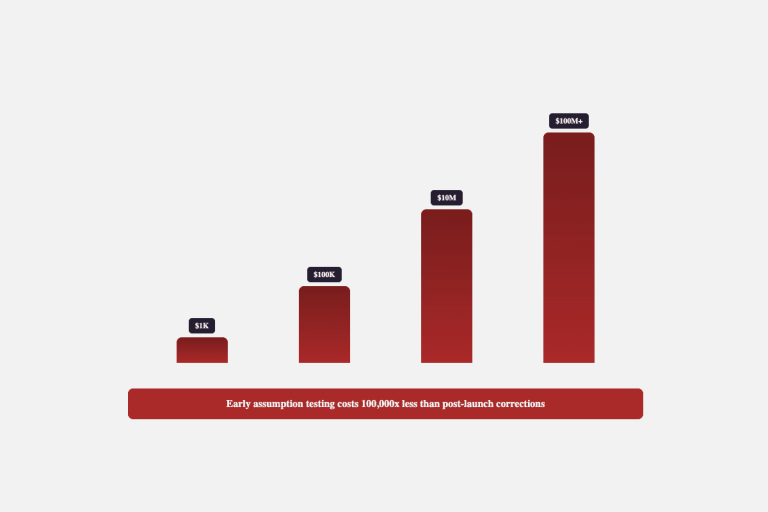
Discover how tech giants like Netflix and Amazon lead not through superior tech but by embracing discovery-driven planning. Their success lies in the systematic approach to testing assumptions, embracing failure, and rapid learning.

Apple has always had a flair for marketing. But even in the early days, this wasn’t without its controversies.

Since Apple was founded, a number of big changes have swept the technology world. Your clients live in a very different world. As a result, you market in a different environment.

Vision drives new products. But too much vision can kill them. Where is the line? And what really happens in high-growth startups?

The root cause of launch failures? Not enough external feedback.

For years, I have struggled to articulate exactly why experiments are so valuable, despite my enthusiastically foisting them on unsuspecting founders. The scientific process makes a lot of sense in an academic research context. But what exactly is it’s value in business, other than being trendy in the Lean Startup crowd?

You can learn a lot about a new product idea by figuring out analogies customers use to understand it. If it works with movies, it will definitely work with landing pages and prototypes.

Getting boundaries right helps achieve goals and fuels a healthy creative practice. Critical for innovation.